
Look Again Episode 2.5: The Code of the Slow-Burn [Part 1/3]
On shringara, and why the hardest thing in art was ranked first

The most-discussed television of the last few years, among a certain kind of viewer, is built almost entirely on people not touching each other.
Six episodes of a hand not taken. A conversation that ends one sentence early. Two people in a car, and the whole scene is about whether one of them will say the thing, and they don’t, and the episode ends. The comment sections have a word for it. The “yearning”.
It is being hailed as a sort of discovery – a corrective to a few decades of content that mistook explicitness for intensity. As something re/discovered by accident. Almost as if an industry that stumbled onto restraint suddenly found it worked. The fabled restraint of the Far East has, of course, served only to lend credence to this perspective.
It is not a discovery. There is a manual, it is about two thousand years old, and it was written in India.
What the manual really is
Sometime between 200 BCE and 200 CE, a treatise on the performing arts was compiled on this subcontinent. It is widely attributed to Bharata Muni, though the text accreted across centuries, in many hands, and the attribution is more a convention rather than a claim.
The Natyashastra runs to thousands of verses. It covers stage construction, the training of performers, music, the categories of gesture, the obligations of an audience. It is a highly technical manual, and is not a work of philosophy in the way the later commentaries are. It reads a document written by practitioners, for practitioners, about how to make a thing work.
At its centre is rasa – the proposition that art produces a limited, definable set of distilled emotional states in the person receiving it. Mind you – it is not about depicting the feelings the artist has. It focuses, instead, on the states the work produces. The distinction matters, and it is the reason the whole framework is engineering rather than expression.
The text enumerates eight. Love and desire. The comic. Grief. Fury. Heroism. Fear. Disgust. Wonder. A ninth – shanta, tranquillity – was added later and argued over for centuries.
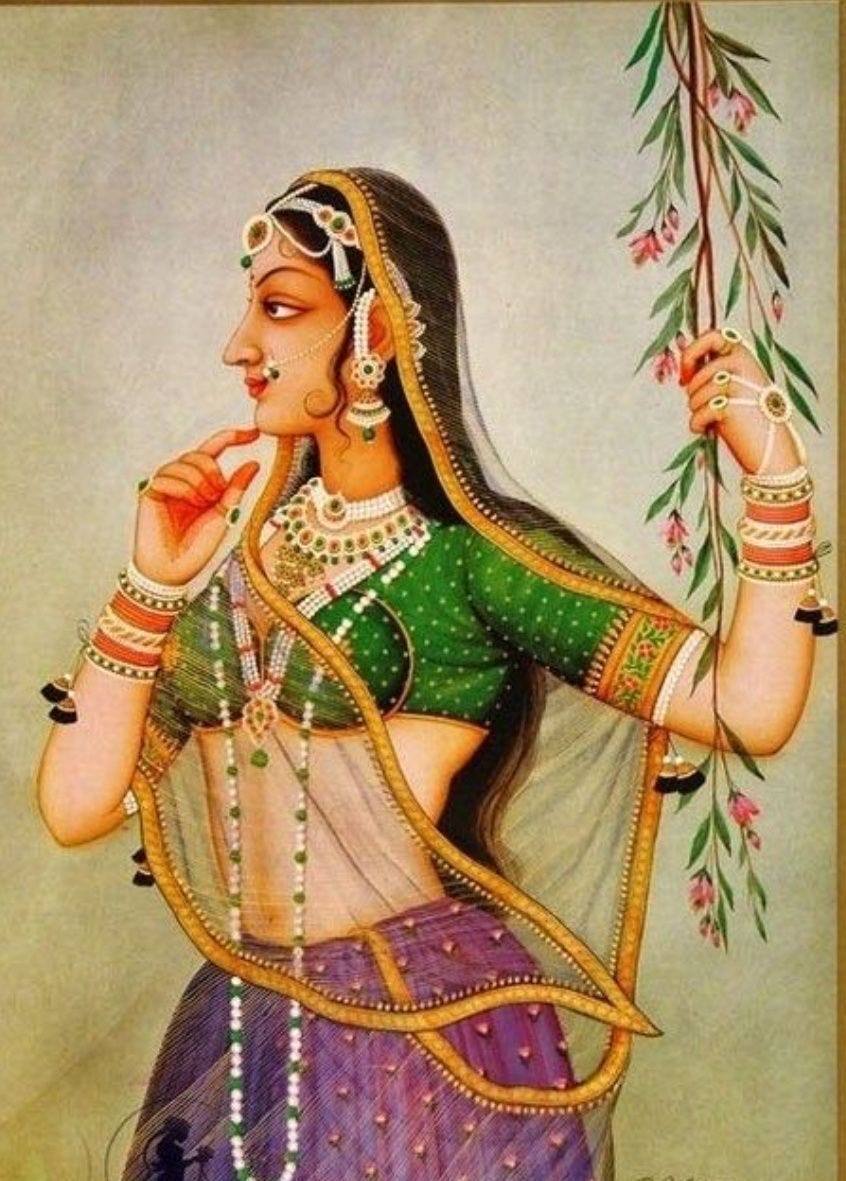
Shringara, the aesthetic experience of love and desire, is listed first. And the tradition that grew up around the text was direct about what that placement meant. Later aestheticians even called it the Rasa-Raja: the king of the rasas, the state from which the others are said to derive.
Why desire and not grief
The instinct is to read this as a culture with complicated attitudes toward sex - either disapproving or relaxed, which is both patronising and wrong. The reason shringāra sits at the top is technical, and it is the most useful idea in the entire framework.
Rasa cannot be asserted. This is the load-bearing principle. You do not produce an emotional state in a viewer by depicting that emotional state – (as we do today) you produce it by assembling components, and the text describes the components in detail.
There are vibhavas: the situation, the setting, the object of the feeling. The determinants.
There are anubhavas: the visible physical consequences. The glance that goes somewhere and comes back. The shift of weight. The change in breath. The involuntary response that the body produces before the mind has authorised it.
And there are vyabhicari bhāvas: the transient states that pass across a performer and complicate the dominant emotion without replacing it. Like notes of a perfume, if you will. Anxiety. Impatience. Recollection. Shame. Weariness. Agitation. Thirty-three of them – each named and enumerated.
Rasa arises when these assemble. The formula in the text is compact and famous: from the conjunction of vibhava, anubhava, and vyabhicari bhāva, rasa is produced. Assembly takes time. It cannot be rushed and it cannot be announced.
And this is why shringāra is the hardest thing on the list.
Grief can be produced quickly. A body on the ground does most of the work. Fear needs a sound and a held breath. Fury needs almost nothing – a raised voice and a viewer will supply the rest.
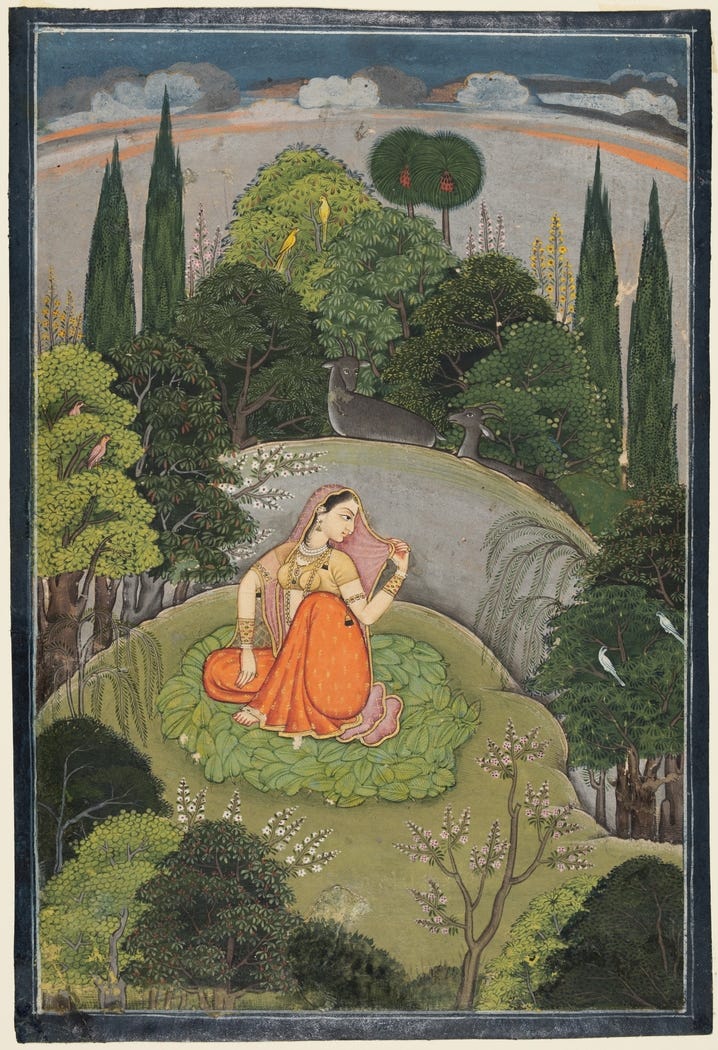
Desire is built almost entirely out of the transients – the vyabhicari bhāvas. As a dancer, I have experienced the “making” of it – it lives in the hesitation, the recollection, the thing almost said and then withdrawn, the approach that only means something because of the withdrawal that preceded it. Strip those out and you don’t get a faster, more “efficient” desire. You get nothing at all. You get information about attraction, or worse, facts about what actually happened during an encounter, rather than the experience of it – which is precisely the failure mode of every explicit scene that leaves a viewer cold.
There is no shortcut. That is the whole reason it was ranked first. It is supremely difficult to get right.
What happened to the framework
This vocabulary did not just stay in the theatre.
The bhakti movements took this language of erotic longing and made it the primary tenor for the relationship between a person and the divine. Andal, a Tamil poet writing in the eighth or ninth century, composes as a girl who fully intends to marry Vishnu and is not being metaphorical about it. Jayadeva’s Gita Govinda, in the twelfth, narrates Krishna and Radha in terms that I’m not sure anyone can ever successfully describe as chaste.
The logic is coherent, and worth following. If the most intense – and complex – human experience of longing is erotic, then erotic language is the most accurate instrument available for describing longing after God. Reaching for a lesser register would not be more reverent. It would be less precise. It may even describe the thing badly.
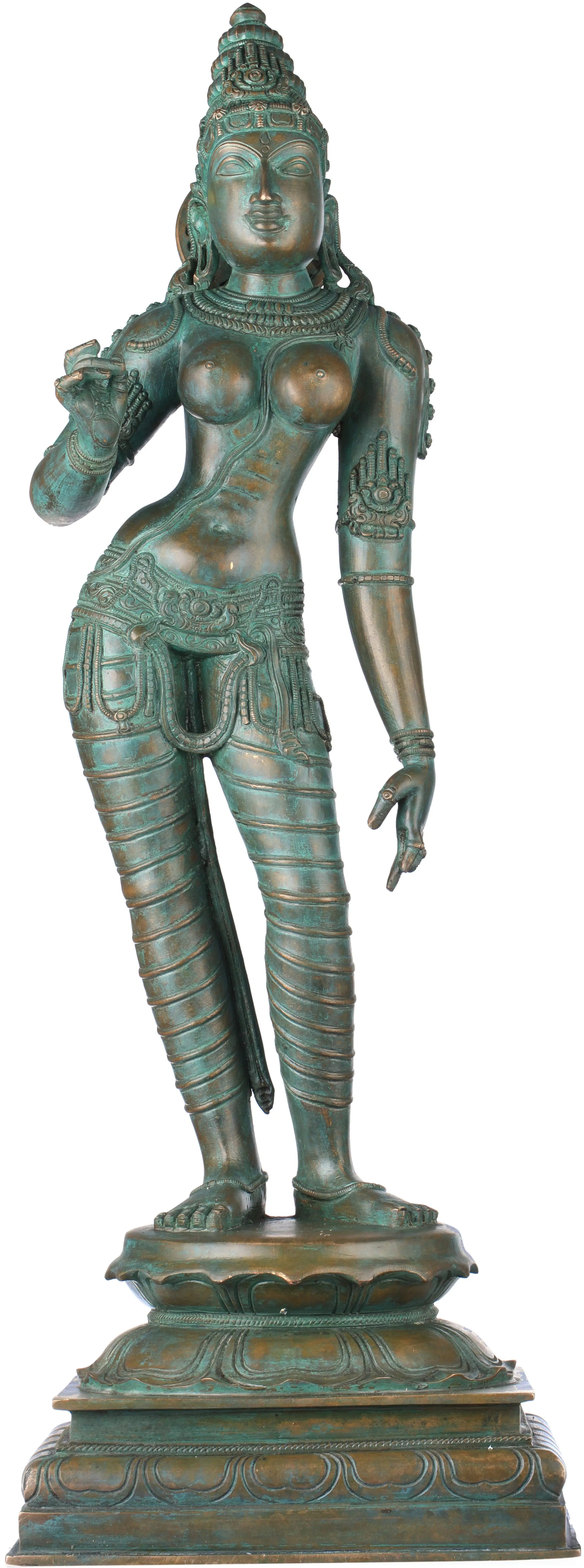
You can see the same confidence in the objects we’ve created through the centuries. A Chola bronze standing in tribhanga – three bends through the body, weight thrown onto one hip, the figure caught mid-breath and entirely unapologetic about occupying space. Nothing in the modelling suggests the maker thought the body was a problem to be managed.
The building as an argument
The strongest evidence, however, in my humble opinion, is not any single sculpture. It is the architecture.
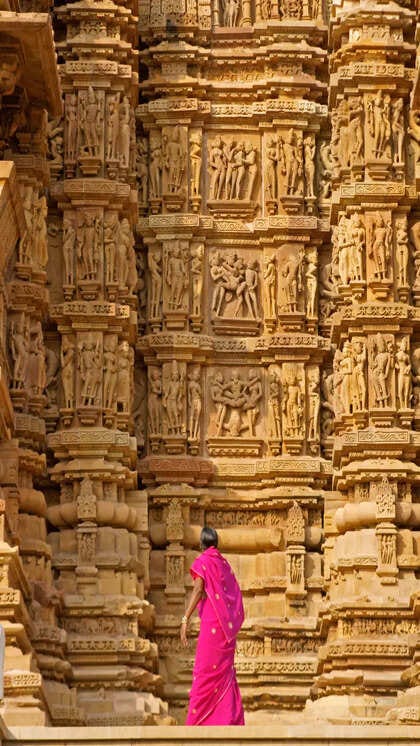
Take Khajuraho. The exterior walls are dense – layered bands of carving running around the whole structure, crowded with the full spectrum of earthly existence. War. Music. Court life. Animals. Deities. And, among all of it, the explicit erotic sculpture that the site is now known for, positioned on the outer walls almost at eye level, in full public view, where every worshipper does their pradakshina - circumnambulation - on the way in.
Then you go inside.
And the ornament thins. You cross into the mandapa and there is less. You move further and there is less again. The light drops. The scale contracts. And at the centre you reach the garbhagriha – the womb-chamber – and it is bare. Dark, small, silent, undecorated. Nothing on the walls around the deity at all.
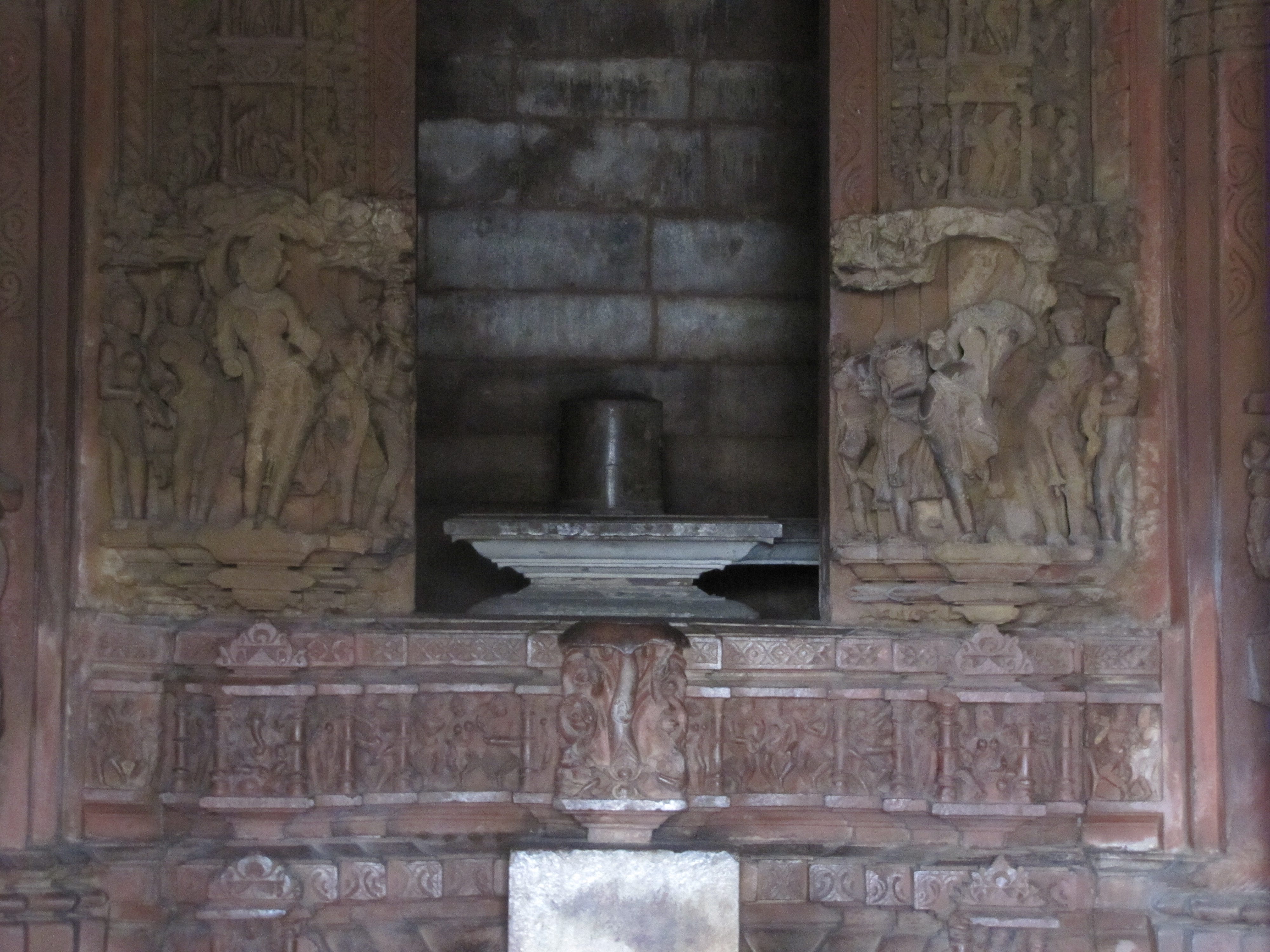
I’m not sure what you’ve been told, but guess what. The building is not a container for sculpture. The building is an argument, and the sequence is the argument.
It says: you do not arrive at the divine by pretending the material world isn’t there. You arrive by walking through it – the whole of it, at full intensity, including desire, including the body – and exhausting it, and leaving it at the threshold. The stripping-away is not a rebuke to what came before. It only works because of what came before. An empty room at the end of an empty corridor means nothing. An empty room at the end of that ornate, vibrant corridor means something specific.
Which is why the placement of the erotic sculpture on the exterior is not a scandal requiring explanation - it is structural. It is the first thing you pass through because it is the first thing to be worked through. When you really think about it, it makes perfect sense.
A little disclaimer at this point about what remains contested here: scholars have argued for decades about what the Khajuraho carvings specifically meant – there are tantric readings, auspicious and apotropaic readings, readings that situate them within kāma as one of the four legitimate aims of life, readings about the display of royal prosperity and confidence. None of it is settled, and anyone who tells you it is has stopped reading about it.
But I think none of that matters – because all those disagreements don’t touch the real point. Whatever those carvings meant, they were on the outside of the building, at eye level, in daylight. The debates may have been about interpretation… but they have never been about concealment. Nobody was hiding them.
An ancient mechanism
So the slow burn works on you, and it works on a hundred million other people, and the reason is not that a Korean production company solved something new.
It is that the mechanics of longing are stable. They were mapped here with more rigour than anywhere else, and the mapping was done by people who considered the assembly of desire the highest technical achievement available to an artist. You are responding to a system that was described, tested, taught, and built into stone on this subcontinent for two thousand years.
But. That system did not survive intact.
It was subverted from two directions, and both are worth understanding separately, because they are not the same and they did not arrive at the same time.
The one we talk most about is the Victorian one – the imported conviction that the body is a moral failure and desire is dirty. That one came by ship. It is genuinely foreign to everything the Nātyashastra argues, and it is the subject of the third essay in this sequence.
But the other one? That was already here. Long before any colonial officer stood in front of Khajuraho and felt embarrassed on our behalf, we had built a brutal system that decided which bodies were permitted to be covered, which were required to be exposed, and what happened to a woman who got it wrong. That system was ours, it was older, and in its consequences it was worse.
That is the next essay.
Part of Look Again, on The Untrained Eye.
Part Two: caste, the upper cloth, and the question of who actually decided what Indian women could wear.
Wow, I'm going to really have to process the erotic language of longing for the divine.